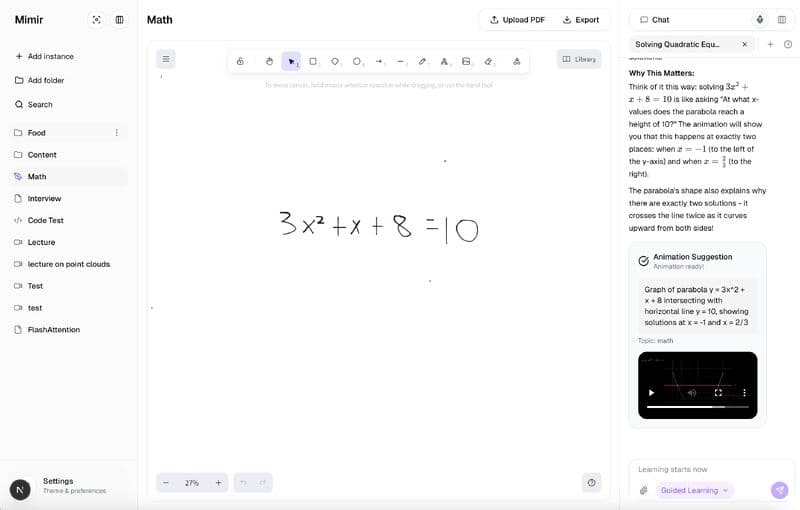

Mimir is an AI-powered tutoring workspace designed to help students actually learn, not just extract answers from language models. It provides full-context tutoring, live guidance, and custom visualizations that walk students through problems step by step—mirroring how a great teacher teaches.
Rather than replacing effort, Mimir restores it.
The Problem
Education today is facing a learning crisis amplified by AI.
Students increasingly paste homework into LLMs, copy the final answer, and move on without engaging with the material. What should be a tool for growth has become a shortcut that bypasses the mental struggle required for learning. Traditional AI tools optimize for speed and correctness—not understanding.
The result is a widening gap between completion and comprehension.
Mimir was built to close that gap.
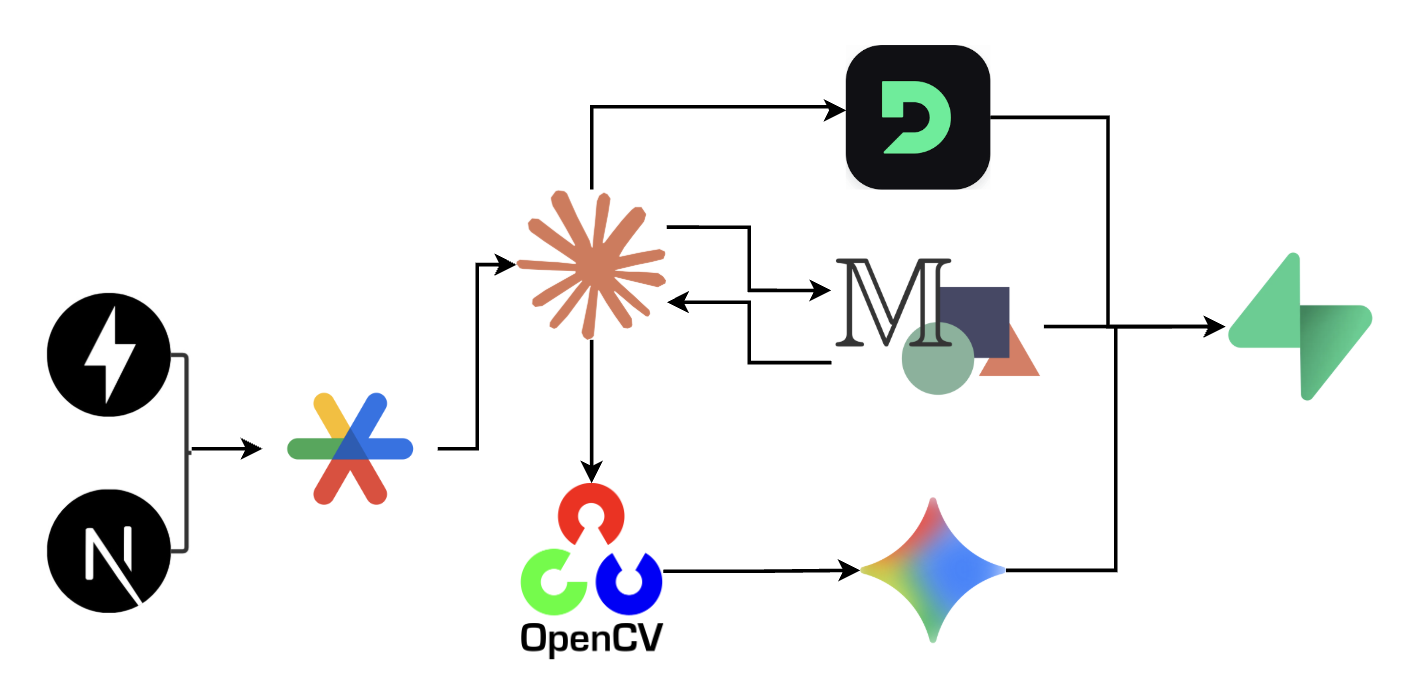
Tech Stack
What Mimir Does
Mimir turns AI into a personalized tutor, not an answer generator, by embedding it directly into a learning workspace.
- Tutor Mode (Live Guidance): An AI tutor with access to the full workspace context guides students through problems step by step—like a real teacher sitting beside them.
- All-in-One Learning Workspace: Students can code in a built-in IDE, read textbooks, write notes, solve math problems, and watch lecture videos in one place.
- Generative Visual Explanations: A custom visual engine scripts and animates mathematical explanations using Manim, breaking complex topics into digestible, step-by-step visuals.
- Active Learning Tools: Automatically generate flashcards, quizzes, and practice problems grounded in the material the student is working on.
- Voice-Enabled Tutoring: Conversational, voice-based sessions allow students to ask questions naturally and reason aloud as they work.
How It Works
Mimir is built around the idea that learning requires context, feedback, and struggle—not just answers.
Full-Context Tutoring
Unlike chat-based AI tools:
- The tutor has access to the entire workspace
- It sees the student’s code, notes, math work, and reference material
- Guidance is contextual and incremental, not solution-dumping
The tutor is explicitly instructed to guide, not solve.
Generative Visualization Engine
Many concepts fail because they’re hard to visualize.
- Mimir uses Manim to programmatically generate animated explanations
- Visuals are tailored to the specific concept the student is struggling with
- Complex ideas are deconstructed into sequential steps rather than static diagrams
This bridges the gap between symbolic math and intuitive understanding.
Multimodal Learning Loop
- Text, code, visuals, and voice are tightly integrated
- Students can switch modalities without losing context
- Voice tutoring enables natural back-and-forth reasoning, mirroring real instruction
System Design
- LLM reasoning powered by Claude
- Workspace-aware prompting ensures responses stay grounded
- Modular architecture allows new learning tools (e.g. quizzes, visualizations) to plug into the same context engine
Challenges & Solutions
- Preventing Answer Dumping: We explicitly designed the tutor to refuse direct solutions and instead scaffold understanding.
- Maintaining Context: Keeping the AI grounded in a rich, evolving workspace required careful context construction and prompt design.
- Visualization Complexity: Generating accurate, pedagogically useful animations demanded tight coupling between math reasoning and visual scripting.
- Cognitive Load: We focused on pacing explanations to support learning without overwhelming the student.
Outcome
Mimir demonstrates how AI can strengthen learning rather than undermine it. By embedding tutoring into the learning process itself—and grounding it in context, visuals, and dialogue—it restores the role of effort, curiosity, and reasoning.
At the CMU Claude Builder Hackathon, Mimir was recognized for rethinking how AI should be used in education—not as a shortcut, but as a teacher.
What’s Next
- Adaptive Learning Paths: Automatically adjust tutoring strategies based on student progress and misconceptions.
- Expanded Visual Library: Richer, reusable visual explanations across math, CS, and physics.
- Collaborative Tutoring: Shared workspaces for study groups and peer learning.
- Institutional Integrations: LMS and course-level deployment for classrooms and universities.